
A complete view of the genome often depends on the regions that are hardest to sequence. Structural variants, repeat expansions, and segmental duplications can shape disease risk, trait biology, and genome evolution, but can be difficult to resolve with short reads.
HiFi long-read sequencing was developed with these regions in mind, and doesn’t require a sequencing system in the lab. PacBio certified service providers around the world run HiFi sequencing for academic, translational, and industry research teams, and many now offer SPRQ-Nx chemistry on the Revio system. A project run with one of these providers not only gets high-quality long-read data, but also the experience needed to plan, run, and analyze it well.
For a closer look at how SPRQ-Nx performs in practice, watch our on-demand webinar featuring early-access users.
Planning considerations before sequencing begins
Coverage, input amounts, and sample handling all depend on what a study aims to answer, so it helps to work through them with a provider early in planning. The right sequencing depth varies with the application. Germline variant detection in human genomes commonly targets 20x to 30x coverage, while de novo assembly and somatic variant studies typically need greater depth. Settling these targets early helps make sure enough DNA is available to reach them.
Sample collection, storage, and shipping conditions are all important considerations, since sample quality directly affects read length and yield. Flash-freezing tissue, storing samples at minus 80°C, limiting freeze-thaw cycles, and shipping on dry ice all help preserve long DNA fragments. Input amounts vary by application and sample type, so it also helps to discuss each provider’s minimum DNA mass and concentration for the planned workflow. Collecting extra material where possible leaves room for repeat QC or a second library.
Data outputs are another useful topic for early conversations. Providers can walk research teams through what to expect, including file formats, how methylation information is reported, which analyses are included, and typical turnaround times.
Why choose HiFi sequencing
Many service providers offer more than one sequencing technology, so the platform choice often comes down to what the research question needs. Short reads can struggle in repetitive or highly similar regions, where a single read may map equally well to several locations. Variants in those regions can be missed or misassigned. HiFi reads are long enough to span these regions and accurate enough to separate true variants from sequencing errors. This combination supports phased haplotypes, more contiguous assemblies, and variant calls across a larger share of the genome. Additionally, HiFi whole genome libraries are not PCR amplified, so coverage stays uniform across GC-rich and other difficult regions.
HiFi sequencing also captures more than base sequence. Methylation is detected directly from native DNA in the same run. That includes 5mC at CpG sites, 5hmC, and 6mA, which is a common mark in bacterial genomes. 6mA detection is also the basis for Fiber-seq, which maps chromatin accessibility and nucleosome positioning on individual long molecules. Together these signals link the genomic sequence to epigenetic variation within the same dataset, which is especially useful when sample material is limited.
The same platform supports applications beyond whole genome sequencing. Targeted sequencing focuses coverage on specific genes or loci, such as pharmacogenes or repeat expansion regions. Full-length RNA sequencing captures complete transcript isoforms without the need for assembly. HiFi accuracy also benefits microbiome and metagenomic studies, where it supports species and strain resolution and the recovery of complete metagenome-assembled genomes.
SPRQ-Nx chemistry on the Revio system
SPRQ-Nx is the latest chemistry update for HiFi sequencing on the Revio system. Optimized enzyme concentrations allow SMRT Cells to be reused, and the instrument washes them automatically between uses, while library preparation, DNA input requirements, and instrument handling stay the same.
SPRQ-Nx also expands the methylation information available from each sample. It adds 5hmC detection alongside improved 5mC calling and consistent 6mA performance. Overall performance is equivalent to or better than the previous SPRQ chemistry, and the majority of bases are called at Q40 accuracy. Yield and accuracy remain consistent across SMRT Cell uses.
For research teams working with a service provider, these updates can make larger cohorts, deeper coverage, or added methylation analysis more practical within an existing budget. The workflow is unchanged, so providers can bring SPRQ-Nx into their established operations without changing how samples are prepared.
How service providers support long-read projects
Service providers give research teams access to experience and infrastructure that take time to build in-house. Their scientists have worked through many study designs and can advise on sample handling, coverage, and analysis before a project begins. They supply the instruments, computing capacity, and data storage, along with established quality control processes. Workflows can scale from a pilot study to hundreds or thousands of samples. Many providers also adapt protocols to unusual sample types, specialized applications, or particular data formats.
This flexibility suits groups at different stages. A lab that is new to long-read data can evaluate it before investing in instruments and training. Groups with in-house sequencing can add capacity during a large study or ahead of a publication deadline. Core facilities and collaborators can also reach workflows that their own labs run only occasionally.
The benefits carry over to HiFi sequencing specifically. Certified service providers have completed PacBio’s certification process and have experience across the full long-read workflow. That includes high molecular weight DNA extraction, library preparation, sequencing, and data analysis. Research teams can then put more of their attention on experimental design and interpretation.
Certified providers offering SPRQ-Nx chemistry
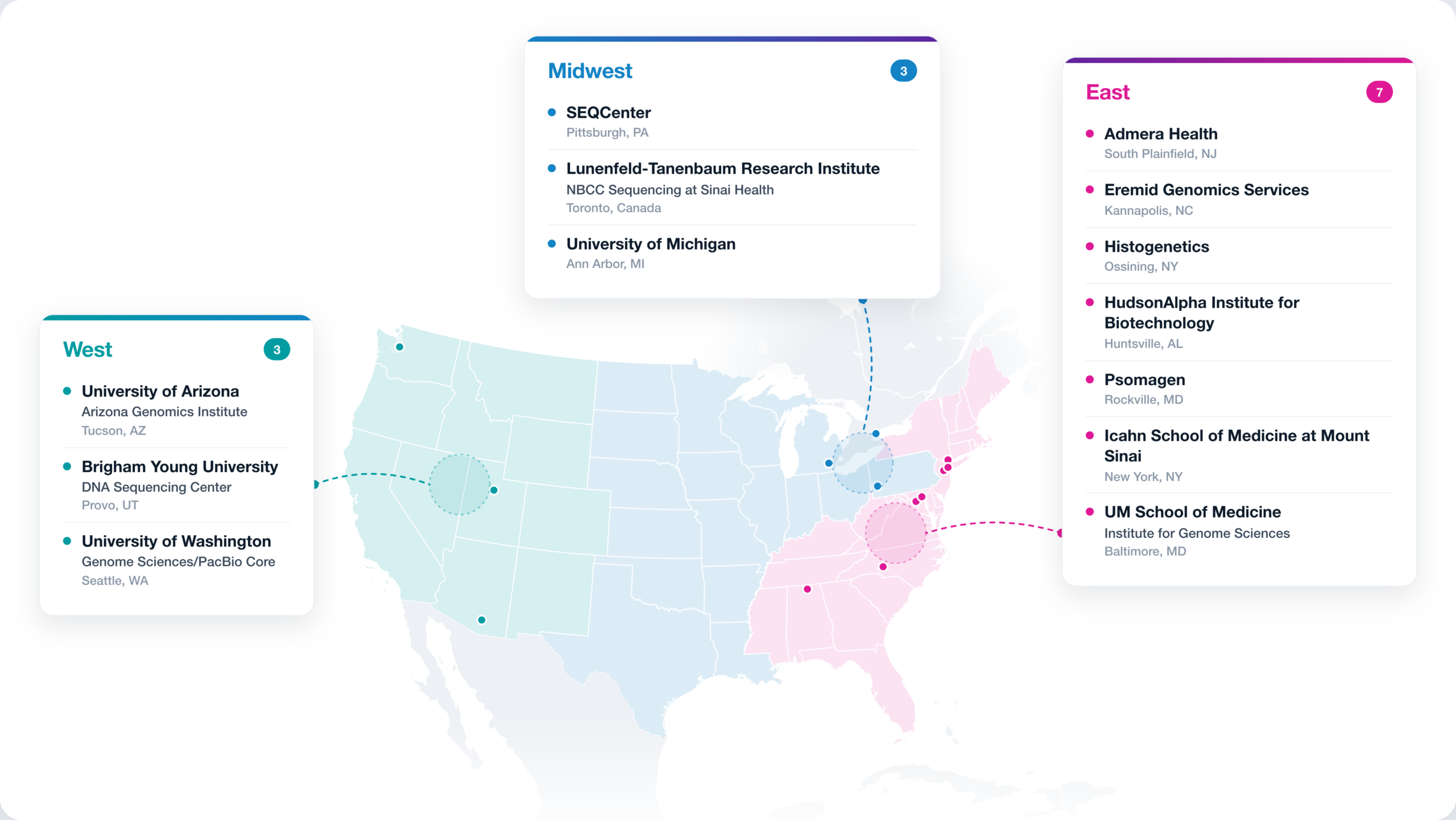
The providers below have adopted SPRQ-Nx chemistry for HiFi sequencing services in the Americas:
AMR West (3)
- University of Arizona – Arizona Genomics Institute (Tucson, AZ)
- Brigham Young University – DNA Sequencing Center (Provo, UT)
- University of Washington – Genome Sciences/PacBio Core (Seattle, WA)
AMR Midwest (3)
- SEQCenter (Pittsburgh, PA)
- Lunenfeld-Tanenbaum Research Institute (NBCC Sequencing at Sinai Health) (Toronto, Canada)
- University of Michigan (Ann Arbor, MI)
AMR East (7)
- Admera Health (South Plainfield, NJ)
- Eremid Genomics Services (Kannapolis, NC)
- Histogenetics (Ossining, NY)
- HudsonAlpha Institute for Biotechnology (Huntsville, AL)
- Psomagen – Rockville (Rockville, MD)
- Icahn School of Medicine at Mount Sinai (New York, NY)
- UM School of Medicine – Institute for Genome Sciences (Baltimore, MD)
A complete list of certified service providers is available at pacb.com/certified-service-providers.
Expanding access to HiFi data
Long-read sequencing is most valuable when it reaches the projects that need it, and experienced service providers bring HiFi data to a wider range of research teams. As HiFi sequencing continues to become more accessible with more information included in each dataset, it is now possible to design more studies around complete genomes from the start, instead of adding long reads later to fill gaps.
Certified service providers help make this a reality for labs of all sizes. Wider access to long-read sequencing has the potential to raise the baseline for genomic research, so that a more complete view of the genome becomes a common starting point for discovery.