
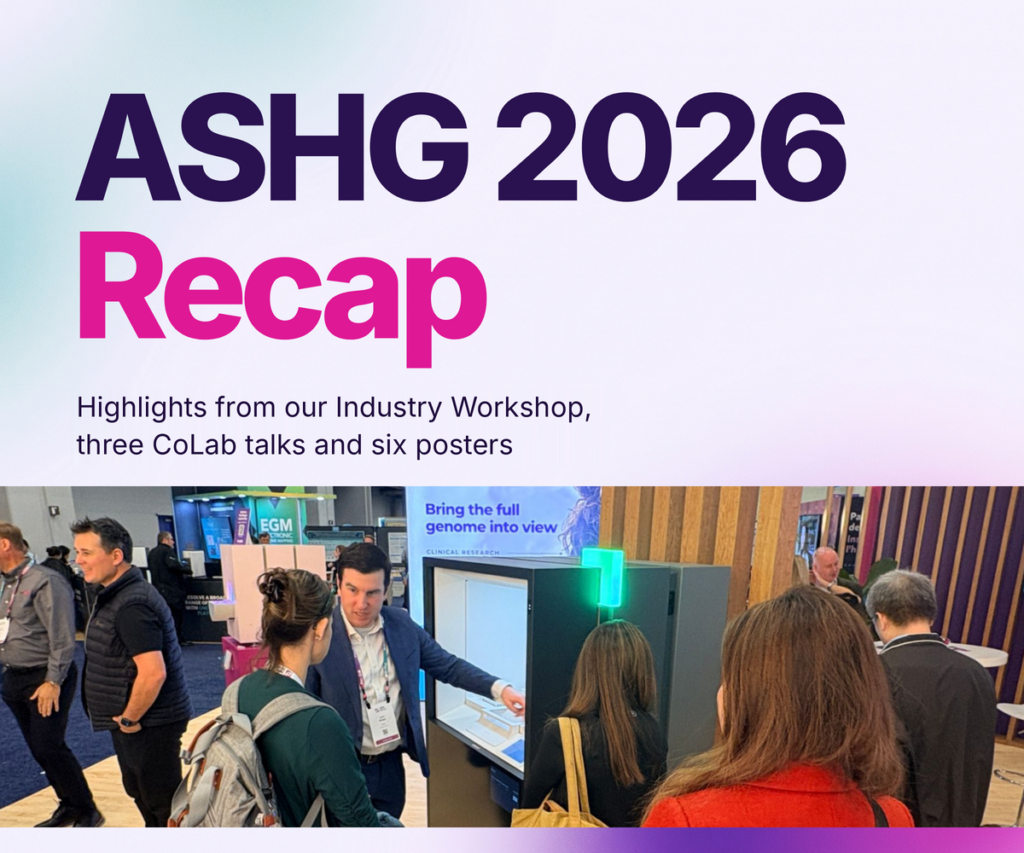
ASHG 2026 brought the human genetics community to Montréal this past October for a week of science spanning rare disease, cancer, population genomics, and new approaches to working with genomic data at scale. For the PacBio team, it was also a valuable chance to hear directly from researchers about the questions they are pursuing and where open questions remain.
Between packed session rooms and steady conversation on the exhibit floor, the meeting reflected how quickly the field is moving toward richer genomic data. Through an industry workshop, CoLab sessions, and posters, customers and collaborators shared how HiFi long-read sequencing is helping bring those layers into view in settings that range from population-scale programs to clinical research laboratories.
Many of these discussions returned to biology that has been difficult to reach with traditional methods. Structural variants, repeats, isoforms, and methylation patterns often hold the context behind unexplained findings, yet short-read data leave much of it unresolved. For a closer look at the types of variation short reads miss and how HiFi sequencing captures them, explore our new variant guide.
HiFi sequencing at scale
The industry workshop opened with a look at the growing momentum behind HiFi sequencing, as cumulative customer data output continues to climb each year with more laboratories gaining a more complete view of the genome and putting the technology to work. Updates across the workflow followed, including on-instrument detection of 5mC, 5hmC, and 6mA alongside the four DNA bases, faster analysis tools, and a rapid whole genome sequencing workflow also featured on the poster floor.
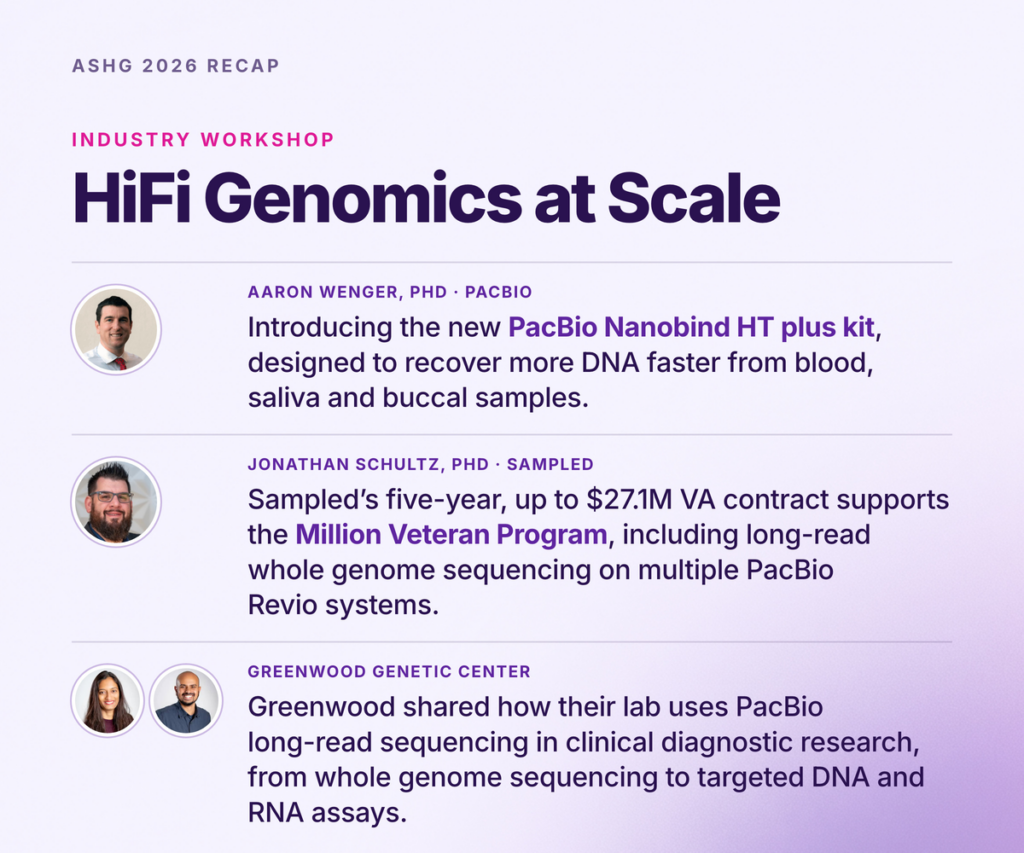
The session also introduced the new Nanobind HT plus kit for high-molecular-weight DNA extraction from blood, saliva, and buccal samples. The kit replaces the Nanobind disk with beads to improve DNA capture, particularly from lower-mass samples, while retaining the existing Nanobind buffers that preserve purity and DNA quality. The bead-based format is simpler to automate on the KingFisher Apex system, and extracted DNA can move directly into library preparation without overnight solubilization.
Interest in using HiFi data for AI was another theme, since accurate sequence, native methylation, and full-length transcripts give models consistent, multi-layered information to learn from. TychoBio is working with PacBio to build AI models for rare disease RNA therapies using Kinnex full-length RNA data, and as TychoBio founder and CEO, Felix Raimundo emphasized,
AI models are only as good as the data they are trained on. To effectively identify new rare disease treatments, we needed the highest quality biological data, which can only be generated using PacBio HiFi sequencing technology.
Basecamp Research has also selected HiFi sequencing for its trillion-gene atlas initiative, and a multi-year collaboration with Verily pairs HiFi data and phenotypic information with standardized analysis workflows in Verily’s Trusted Research Environment.
Customer presentations began with Jonathan Schultz of Sampled, who described how laboratory automation, SPRQ chemistry, and a scaled-out fleet of Revio systems came together to deliver 3,304 HiFi genomes for the Million Veteran Program, a U.S. Department of Veterans Affairs research program that has enrolled more than one million Veterans.
Sneha Mokashi and Adithya Kandhadai of Greenwood Genetic Center then described how a single validated long-read genome test on Revio now covers variant classes that previously required short-read WGS, repeat sizing assays, targeted Sanger sequencing, and optical genome mapping. Examples included a PLIN4 repeat expansion identified after an uninformative short-read genome.
Fabio Cunial of the Broad Institute closed the workshop with structural variant integration for the All of Us Research Program, which now spans more than 12,000 samples from four sequencing centers. To keep small numbers of false calls from accumulating across the cohort, Cunial’s team combined multiple callers, machine learning filters, and a graph-based genotyper, producing a callset of about 2.5 million structural variants of 50 bp or larger for roughly $0.10 to $0.20 per sample.
Episignatures from native methylation
Moving to the CoLab sessions, the first asked how methylation can help turn uncertain rare disease findings into meaningful answers. Episignatures, the reproducible DNA methylation patterns shared by individuals with the same disorder, can offer functional evidence to help interpret variants of uncertain significance.
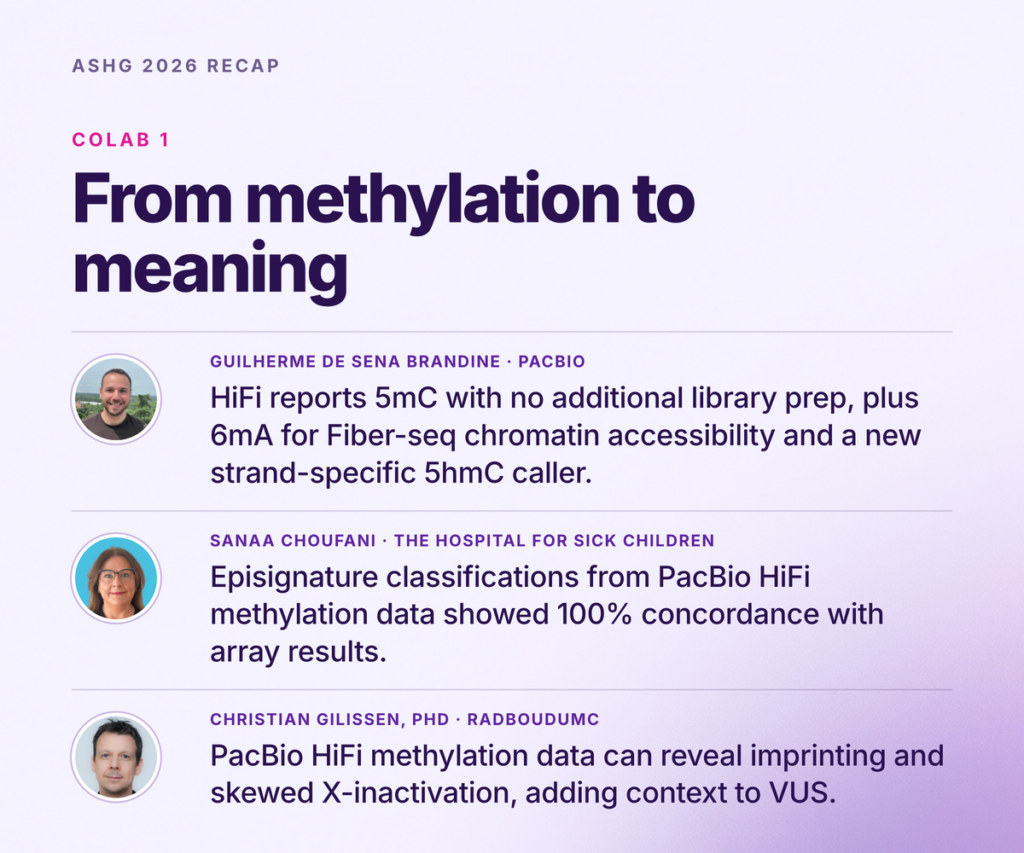
Sanaa Choufani of The Hospital for Sick Children reported that in a pilot of 47 samples, episignature classification using HiFi methylation data was fully concordant with array results. Because HiFi reads measure methylation genome-wide rather than at preselected probes, her team identified 22 differentially methylated positions associated with NSD1 variants, compared with three captured by the array. In one research case with negative exome and genome results, HiFi data confirmed the expected methylation signature and uncovered a deep intronic variant within the same assay.
Christian Gilissen of Radboud University Medical Center shared haplotype-resolved methylation at 24 of 25 imprinted regions and a workflow that applies published episignatures to HiFi data against a reference cohort of more than 4,300 Revio genomes.
Long-read whole genome sequencing for clinical research
The second CoLab considered how complete a whole genome really is, and whether a single, more comprehensive test could shorten the path to answers in clinical research. The session opened with recent publications evaluating HiFi WGS on real-world samples. In one study of 191 rare disease research samples, HiFi WGS detected 99.6% of 481 known pathogenic variants, and work from Children’s Mercy Kansas City reported a mean turnaround of 27 days compared with 62 days for standard testing.
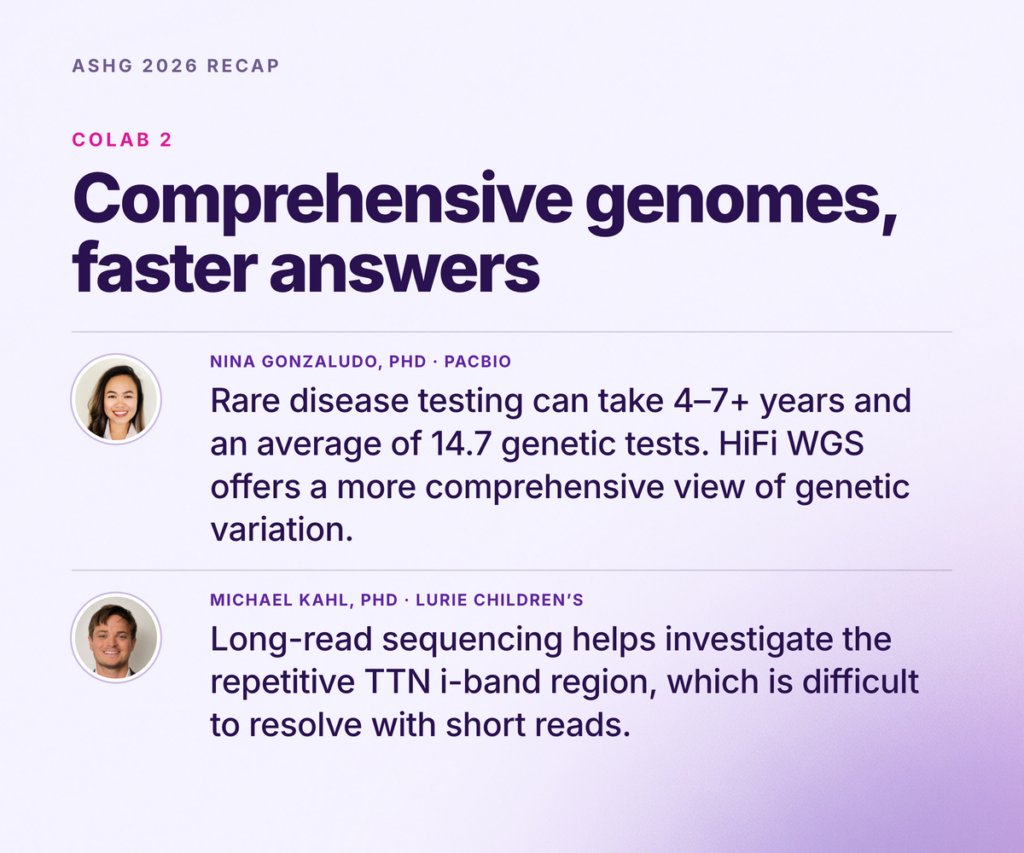
Michael Kahl of Lurie Children’s Hospital of Chicago then shared results from a research study of families who remained unsolved after conventional testing. Among 29 families, long-read genome sequencing identified additional findings in roughly 28%, including a 6.47 Mb inversion disrupting NSD1 that short-read exome sequencing had not detected and a frameshift deletion within the highly repetitive TTN I-band region. His team also showed that Fragile X repeat sizing and Prader-Willi and Angelman methylation profiles can be assessed from the same genome.
Consolidating repeat expansion testing
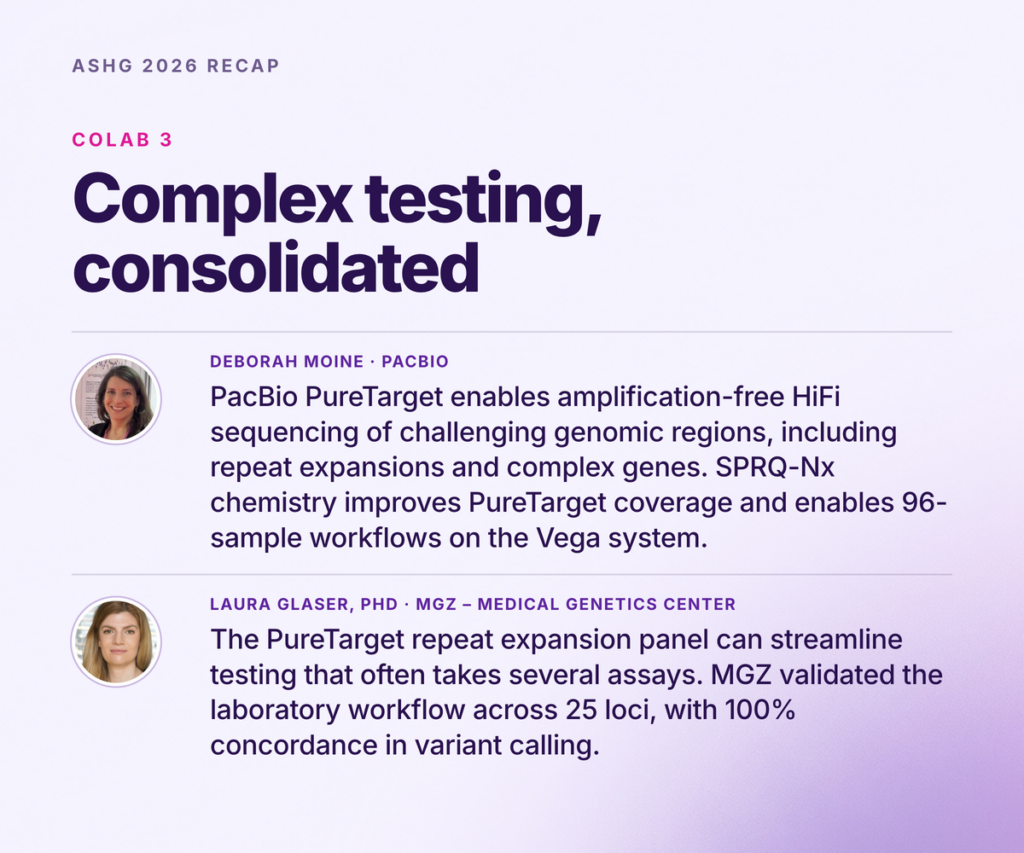
The final CoLab explored whether complex targeted testing, particularly for repeat expansions and genes with close pseudogenes, can be brought together in one workflow. Laura Glaser of MGZ Medical Genetics Center in Munich described how her lab previously relied on fragment analysis, Sanger sequencing, and multiple nanopore panels to cover repeat expansion targets. By adopting PureTarget, which uses PCR-free enrichment to sequence many repeat loci in a single multiplexed run, her team validated one repeat expansion workflow across 25 loci. She also shared practical lessons, including the importance of DNA quality and of adjusting coverage expectations for longer expanded alleles.
Highlights from the poster sessions
Six PacBio posters extended these themes, introducing new tools and workflows across epigenetics, repeats, transcriptomics, and sample preparation.
Simultaneous genetic and epigenetic profiling. HiFi 5mC calls showed strong agreement with whole-genome bisulfite sequencing, supporting genetic and epigenetic analysis from a single dataset. The poster also covered 6mA detection for EpiCypher’s Fiber-seq assay, which enables joint profiling of CpG methylation and chromatin accessibility on individual DNA molecules, providing a high-resolution view of the genome sequence and epigenetic landscape.
Methylation in multiple myeloma. Using the MethBat toolkit, this study detected both genome-wide hypomethylation and localized hypermethylation of CpG islands in multiple myeloma cell lines, showing how one long-read dataset can recover known tumor epigenetic signals alongside genetic variants.
Resolving D4Z4 in FSHD. With the Kivvi tool, PacBio and collaborators at GeneDx and Leiden University Medical Center characterized the D4Z4 repeat associated with FSHD across 601 individuals from five ancestral populations, moving closer to consolidating multiple FSHD assays into a single sequencing workflow. Learn more in the FSHD blog.
Rapid HiFi WGS. Developed with GeneDx, an accelerated workflow goes from blood to VCF in under 30 hours and detects previously characterized variants in 29 of 31 samples, bringing comprehensive long-read variant detection into a timeframe suited to time-critical research. Read more about rapid HiFi whole genome sequencing or explore the rapid WGS resource bundle.
Full-length RNA at cohort scale. Isocall enables joint isoform calling across hundreds of samples, supported by new workflows for Kinnex full-length RNA data, making population-scale studies of transcript diversity more practical.
One-hour HMW DNA extraction. Automated extraction with the Nanobind HT plus kit recovered high-quality DNA from blood and saliva across 308 samples with consistent HiFi WGS and PureTarget performance, helping large studies work with non-invasive sample types without compromising long-read data quality.
Completing the genomic picture
Across talks and posters, a common thread emerged. Population programs building structural variant resources, laboratories interpreting variants of uncertain significance, and teams consolidating targeted assays all pointed toward the same need for data that capture more of the genome’s structure and regulation the first time. A genome is not finished if the biology researchers need is still unresolved, and structural variation, isoforms, and methylation each add context that short reads cannot adequately provide.
The work shared in Montréal also showed how much of that context is already within reach. Laboratories are validating long-read tests, large programs are scaling HiFi to thousands of genomes, and new tools are making methylation, repeats, and full-length transcripts easier to analyze alongside sequence.
For teams considering where long reads could help first, our new variant guide explores the variation short reads miss and the published studies behind it.