Blog

March 27, 2014
As Genome Editing Gains Traction, SMRT Sequencing Provides Accurate View of Results
A new paper published in Cell Reports describes how Single Molecule, Real-Time (SMRT®) Sequencing can be used to greatly improve outcome reporting for a variety of popular genome-editing approaches. “Quantifying…
March 26, 2014
Importance of Finished Microbial Genome Highlighted for Ethanol-Generating Clostridium
A paper in BioMed Central’s Biotechnology for Biofuels journal demonstrates how finished microbial genomes using Single Molecule, Real-Time (SMRT®) Sequencing are having an impact on the biotechnology industry. The publication,…

March 21, 2014
ABRF Preview: Off to the Land of Core Labs and Hot Air Balloons
Members of the PacBio team will be heading down to Albuquerque this weekend for the annual conference of the Association of Biomolecular Resource Facilities (ABRF). It’s a big year for…

March 19, 2014
Assessment of Highly Complex Alternative Splicing of Neurexins Performed with SMRT Sequencing
A new paper in the Proceedings of the National Academy of Sciences from the laboratories of Stephen R. Quake and Thomas C. Südhof (both at Stanford University) describes the direct,…

March 14, 2014
AGBT 2014 Presentation Videos: SMRT Sequencing at CSHL, Uppsala U., and Baylor College of Medicine
There were several excellent talks showcasing SMRT® Sequencing data at the annual Advances in Genome Biology and Technology conference. If you didn’t have the opportunity to see them in person,…

March 3, 2014
In Acinetobacter Study, Long Reads Aid in Defining Genomic Structure
A paper recently published in mBio, an open access journal from the American Society for Microbiology, reports on the sequencing and phylogenetic analysis of several drug-resistant strains of a pathogen…
February 18, 2014
AGBT Day 3 Highlights: Single Contigs, Dazzling Assemblers, Novel Isoforms & Honey Algorithms
Friday morning’s talks were exceptional, and included genomics heavy-hitters Dick McCombie and Gene Myers — both scientists who were truly influential in sequencing the human genome so many years ago….
February 15, 2014
AGBT Day 1 & 2 Highlights: Hello GRCh38 & SMRT Sequencing for Pathogen Screening
AGBT 2014 is off to a roaring start – the opening reception was hastily moved indoors when an impressive thunderstorm joined the party. Wednesday’s kickoff plenary session offered an insightful…

February 12, 2014
Data Release: ~54x Long-Read Coverage for PacBio-only De Novo Human Genome Assembly
We are pleased to make publicly available a new shotgun sequence dataset of long PacBio® reads from a human DNA sample. We previously released sequence data using Single Molecule, Real-Time…

February 11, 2014
AGBT 2014 Preview: Long reads, long flight, long days!
We are flying cross-country to Marco Island, Florida, to attend the fifteenth annual Advances in Genome Biology and Technology conference and, as we have done for years now, we are…
January 29, 2014
At Plant & Animal Genome Workshop, Users Showcase Projects Enabled by SMRT Sequencing
Earlier this month, we hosted a workshop at the International Plant & Animal Genome (PAG) conference in San Diego entitled “A SMRT® Sequencing Approach to Reference Genomes, Annotation, and Haplotyping.”…
January 23, 2014
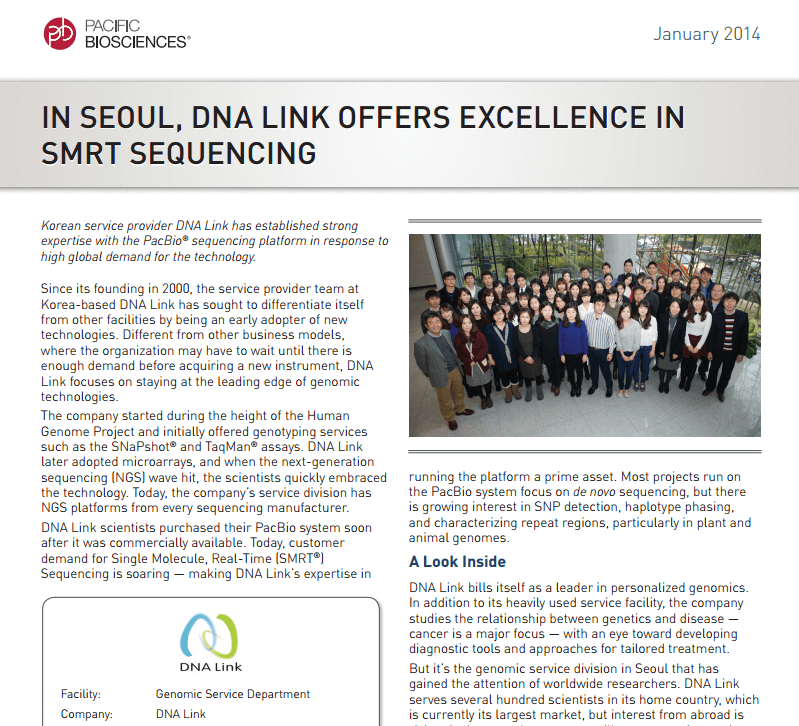
PacBio Service Provider DNA Link Sees Soaring Global Demand for SMRT Sequencing
Since its founding in 2000, the service provider team at Korea-based DNA Link has sought to differentiate itself from other facilities by being an early adopter of new technologies. The…

January 21, 2014
Genome Research Paper: Resolve Complex Genomic Regions for a ‘Fraction of the Cost’ With SMRT Sequencing
A new Genome Research paper describes the application of Single Molecule, Real-Time (SMRT®) Sequencing to resolve repeat-heavy genomic regions in important reference genomes such as human and chimpanzee. In the…
January 16, 2014
Looking Ahead: The 2014 PacBio Technology Roadmap
By Jonas Korlach, Chief Scientific Officer 2013 was an eventful and exciting year for PacBio. As I described in the 2013 roadmap post a year ago, we have applied numerous…
January 13, 2014
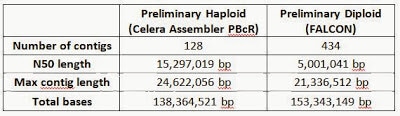
Data Release: Preliminary de novo Haploid and Diploid Assemblies of Drosophila melanogaster
Model organisms such as yeast, Arabidopsis and Drosophila have been essential to progress in genetic and biomedical research for more than 100 years. Model organisms are the best, fastest, most…