Blog
This blog features voices from PacBio — and our partners and colleagues — discussing the latest research, publications, and updates about HiFi sequencing.
Blog
In Memoriam: Jo Messing, Developer of Shotgun Sequencing
The DNA sequencing community lost one of its founding fathers last month with the death of Jo Messing, director of the Waksman Institute at Rutgers University. Dr. Messing, who died…
When Complete Isn’t Complete: C. Elegans Genome Gets a Makeover
It was the first multicellular eukaryotic genome sequenced to apparent completion, but it turns out the Caenorhabditis elegans reference that’s been used as a resource for the past 20 years…
New NHGRI Human Pangenome Reference Initiative Will Use Highly Accurate PacBio Sequencing
The National Human Genome Research Institute has awarded nearly $30 million for new sequencing and bioinformatics initiatives that aim to better represent the full range of human genetic diversity. An…

Sequencing at the Extremes: Low DNA Input Workflow Enables Study of Tiny Ice Worm with Giant Genome
It was the coolest critter Erin Bernberg (@ErinBernberg) had ever worked with – quite literally. The senior scientist at the University of Delaware Sequencing and Genotyping Center, a PacBio certified…
SOLVE-RD Team Adopts PacBio Sequel II System to Solve Rare Diseases
Great news from the rare disease community: the European research program SOLVE-RD has chosen SMRT Sequencing technology to help reveal the genetic mechanisms responsible for these tough-to-diagnose genetic diseases. As…

Webinar: No-Amp Targeted Sequencing Yields Base-Level Resolution of Hard-to-Amplify Regions
Until recently, enriching for certain regions of the genome has been virtually impossible. Repeat expansions, extreme GC regions, and other genomic elements are very difficult to target using traditional enrichment…
From Parakeet to Potoo, International Consortium Releases 100 High-Quality Vertebrate Genomes
UPDATE (October 2020): A preprint of the vaquita reference genome has been published. With her distinctive dark eyeshadow, grey lipstick-like markings and delicate disposition, she was a natural film star….
New Initiative to Generate 5,000 High-Quality Microbial Genomes for Chinese Database
An ambitious project to sequence 5,000 microbial genomes was jointly initiated by a consortium of 10 institutions across China, including Nankai University, China CDC, Academy of Military Medical Science, Third Institute…
When Size Matters: Using SMRT Sequencing to Help Patients With Repeat Expansion Disorders
Patients with myotonic dystrophy type 1 (DM1) want to know their size — the size of the expansion of repeats of the unstable CTG sequences that cause the progressive deterioration…
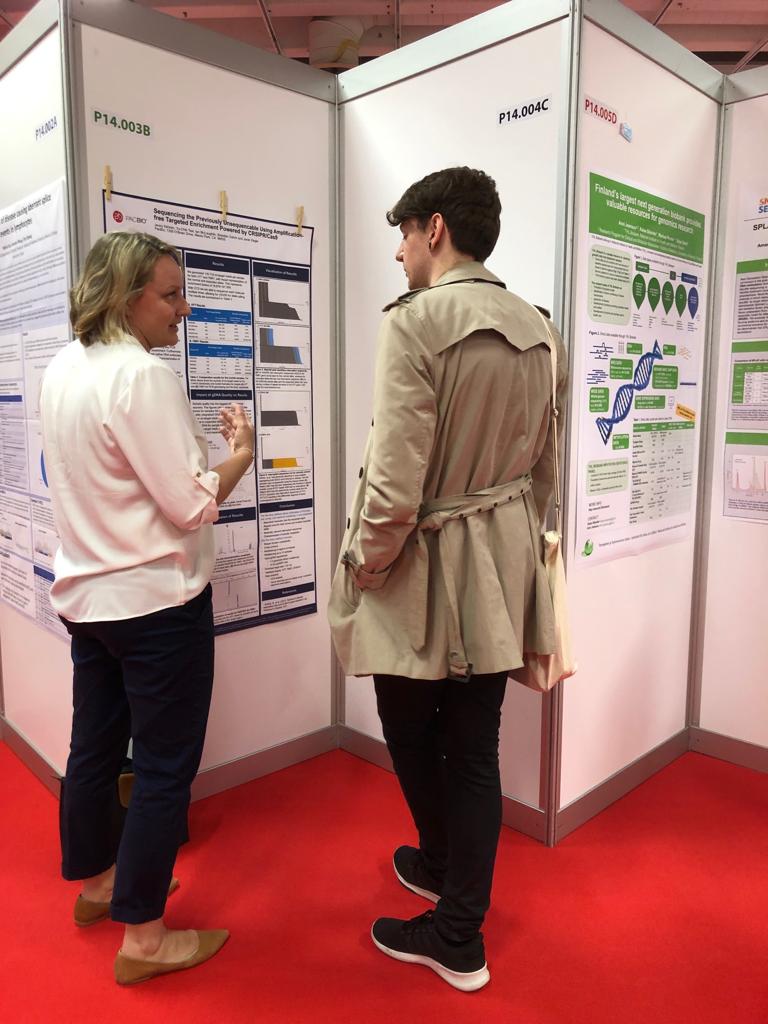
At ESHG, SMRT Sequencing Contributed to De Novo Assemblies, Structural Variant Discovery
The annual meeting of the European Society of Human Genetics — held last month in the sleek Swedish Exhibition & Congress Center in Gothenburg, Sweden — was a terrific assembly…
PacBio HiFi Reads: ‘Most Effective Stand-Alone Technology for de Novo Assembly’
UPDATE: The article is now published in the Annals of Human Genetics. A new preprint evaluates the utility of PacBio HiFi reads for assembly of a human genome. The…
SMRT Sequencing Helps Crack the Code of Elusive Centromeres
Crucial assembly sites and mitosis mediators, centromeres are central to every cell, but missing from even the most complete genome assemblies. Until now. In a PLOS Biology paper, Amanda Larracuente…
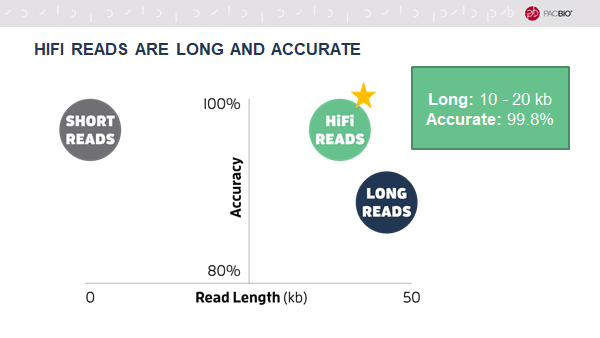
HiFi Reads Add Unparalleled Accuracy to the Long-Read Sequencing Arsenal
To enable better understanding of biology, sequencing data must be accurate and complete. This is especially true when seeking out variants and determining their implications. Luckily, technical and software improvements…
RNA Sequencing SMRT Grant Winner to Help Hone New Therapeutic Strategy in Acute Myeloid Leukemia
Variety is the spice of life, and one of the drivers of genetic variation is gene splicing. After a gene is transcribed, there are alternatively spliced transcripts that add even…
Sanger Scientists Test Sequel II System for Tree-of-Life Projects
Today we offer the final post in our blog miniseries about early access users’ experiences with the new Sequel II System. Shane McCarthy, a scientist at the University of Cambridge…